Well, it has been a while!! Back I’m back to blogging, and am in my second term of being back in a classroom. Up till now I hadn’t really been sure about getting back to my blog, and I wasn’t even sure what to write about. Then this past week we were finishing up the learning for an NCEA standard, and I was getting the students to make a ‘cheat sheet’ – a sheet with a summary of what they thought the might need to know for the assessment next week.
Which caught my fancy because some students asked if they could use Chat GPT to make their cheat sheet. I paused – the whole purpose of the task was for them to summarise what they thought was important – but then figured maybe it could be a good opportunity to explore something different and by getting them to fact check the cheat sheets created it was kind of doing the same thing – what information do I need, what is missing, has it included anything incorrect or irrelevant?
And what followed was a smashing conversation where they taught me all about crafting responses, how to use deep search features and then some crafting and refining of answers. I am 100% confident I learned more than the students!! AND I fully regret not using AI to help me when I first started planning the unit to tease out what it thought the requirements were etc.
So, here is my attempts at replicating my students efforts. (I also made a point of saying please and thank you after reading some articles like this one https://www.nytimes.com/2025/04/24/technology/chatgpt-alexa-please-thank-you.html)
First I just asked for a cheat sheet based on the Achievement standard name and number

So, the first hurdle – This is a level one standard – not L2! AND it decided to include redox reactions, that are not part of this standard….

There was an option to get a printable PDF, and some example questions at the end….
So, of course, trying to refine to remove the redox….
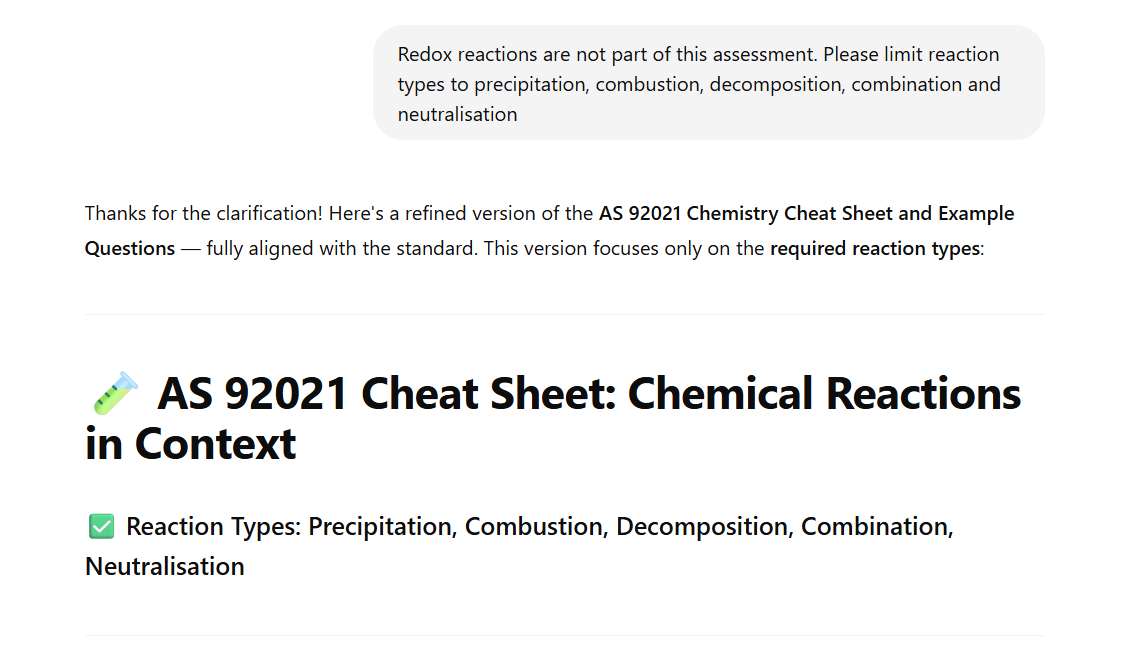
And got this useful snippet

So then after mucking round for a bit more, I went for the deep research option my students had told me about – which then asked for more advice before it went about it.

It took a few minutes, but eventually I was presented with https://chatgpt.com/s/dr_6828154e73948191aab26ec87efbe69a which is not a half bad cheat sheet
I then asked for more diagrams, and got this beautiful doc. https://chatgpt.com/s/m_682817e5325481918e5e9f5fa67c3ecb
I’ve clearly got a bit of learning to do before I reach the even better cheat sheet one of my students got – below (Thanks for sharing it with me) but I have definitely learned a lot about how my students are using AI and how I can include it into my lessons.
NCEA Level 1 Science – CB 1.2 Chemical Reactions Cheat Sheet
Conservation of Mass & Balancing Equations
- Law of Conservation of Mass: Atoms cannot be created or destroyed in a chemical reaction.
- The number of atoms for each element must be equal on both sides of the equation.
Types of Equations:
| Type | Example |
| Word | magnesium + oxygen → magnesium oxide |
| Symbol | 2Mg + O2 → 2MgO |
Steps to Balance an Equation:
- Write correct formulas.
- Count atoms on both sides.
- Add whole-number coefficients to balance.
- Check that atoms are equal on both sides.
Reaction Types
1. Composition (Combination)
- Two or more substances form one product.
- Word: hydrogen + oxygen → water
- Symbol: 2H2 + O2 → 2H2O
2. Decomposition
- One substance breaks into two or more products.
- Often needs heat (thermal decomposition).
- Word: calcium carbonate → calcium oxide + carbon dioxide
- Symbol: CaCO3 → CaO + CO2
3. Combustion
- A fuel reacts with oxygen to release heat/light (exothermic).
Complete Combustion:
- Plenty of oxygen
- Makes carbon dioxide and water
- Example: CH4 + 2O2 → CO2 + 2H2O
Incomplete Combustion:
- Limited oxygen
- Makes carbon monoxide (CO), water, or soot (C)
- Example: 2C3H8 + 7O2 → 6CO + 8H2O
4. Neutralisation
- Acid + base → salt + water
- H⁺ and OH⁻ react to form water
- Word: hydrochloric acid + sodium hydroxide → sodium chloride + water
- Symbol: HCl + NaOH → NaCl + H2O
How to Write and Balance Equations
Tips:
- Balance metals first, then non-metals, then H and O last.
- Never change subscripts—only coefficients.
- If polyatomic ions stay the same, balance them as one group.
- Check that all atoms are balanced (mass is conserved).
Excellence-Level Tips
| Skill | How to Show It |
| Use correct terms | Use “reactants”, “products”, “combustion”, “decomposition”, etc. |
| Explain reactions | Go beyond what happens—explain why it happens. |
| Use detail | Mention things like exothermic/endothermic, gases released. |
| Add data | Use formulas or energy terms like ΔH when possible. |
Model Answers
Q1. Decomposition Reaction
Equation: CaCO3 → CaO + CO2
- Achieved: “One reactant splits into two products.”
- Merit: “Balanced – atoms of Ca, C, and O are equal on both sides.”
- Excellence: “Thermal decomposition is endothermic. Mass is conserved. This reaction is used in making cement.”
Q2. Combustion Reaction
Complete: C3H8 + 5O2 → 3CO2 + 4H2O
Incomplete: 2C3H8 + 7O2 → 6CO + 8H2O
- Achieved: “Propane reacts with oxygen.”
- Merit: “Complete makes CO2 and water. Incomplete makes CO instead.”
- Excellence: “Incomplete combustion happens when oxygen is limited, forming toxic CO and soot. Less energy is released.”
Q3. Neutralisation Reaction
Equation: HCl + NaOH → NaCl + H2O
- Achieved: “Acid and base make salt and water.”
- Merit: “Balanced atoms: H, Cl, Na, O. Mass is conserved.”
- 9 Excellence: “H⁺ and OH⁻ ions form water. pH moves to 7. This is a neutralisation reaction used in titrations.”
Final Test Tips
- Know your reaction types by heart.
- Always balance equations.
- Use correct chemical formulas.
- Explain changes using chemistry terms.
- Link to energy, real-life examples, or environmental impact for Excellence.
 ibpossum takes on tech
Welcome back! To level up next time, maybe get the students to create SLMs using copilot agents or Gemini gems? They can link the SLM to NZQA resources to reduce hallucinations. Also, they can not only generate cheat sheets but also have the agent act as a study buddy, asking questions and testing understanding and giving feedback on the accuracy of their responses.