This is my attempt to unpack some of the Draft Science curriculum released in October 2025. You can find the doc HERE. I am writing this primarily to get my own thoughts in order – to try and understand the document and formulate some feedback – as well as generate some discussion as talking things through helps me get my head round it. If you find any errors, let me know and I’ll do my best to correct – I take full responsibility for any of those 🙂 I did ask a few friends about some concepts, and to double check my understanding – even after nearly 20 years I’m not confident on all the ideas in the doc. I welcome discussion – I am doing my best to keep my mind open while it is reeling about the size of the changes, and the enormity of the task of planning for future teaching and learning programs.
For the Too Long:Didn’t Read folks
Biggest concern – I don’t see how I can teach the yr 10 curriculum in 2027 when students have not had the previous learning, and I am deeply concerned that if there are compulsory Science assessments in the ‘foundational award’ as hinted in the feedback sheet students (and teachers) are being set up to fail.
There seems to be mismatches in content ‘levels’ – including when compared to other curriculum documents, including Te Whariki. For a curriculum so determined to be about progression this is deeply concerning.
I feel a deep sense of bewilderment for my primary colleagues. With soooo much new content across all curriculum levels, how on earth can they design meaningful learning programs. There seems to be links to different curriculums, with no thought to the structure of the schools in Aotearoa, as well as access to specialist subject teachers being completely different. I know Science kits are in the works (More info HERE) – I’d be gutted if Science education was reduced to these kits, especially with the proposed amount of time allotted.
I am concerned that there are no explicit step ups in science ‘practices’ and no cohesive competencies or capabilities to bridge these gaps. (and I seriously disagree with the comments made to media that since nature of Science wasn’t taught well anyway it is no great loss!!)
I don’t think the introduction matches the document
The ‘verbs’ used are very high levels from the get go
There was a big ‘we are failing at PISA’ and we need to do all this change to do better at PISA – and yet we are not following the PISA framework for Science.
I don’t want to get caught up in the ‘mistakes’…. Like sun transferring energy or how ohms law is expressed…..but it doesn’t inspire confidence in the process.
If ALL the content is compulsory through till yr 10 – where does that leave options like AgHort? This has (quite rightly) been added to the senior subject list, and yet there is very little content specific to AgHort in the curriculum – a fair bit on plants in body systems, and maybe some nutrient cycling (some of which is in the soc sci), and a specific mention of agriculture in ecosystems at yr 10 as a human activity. Again, how will students develop those ideas if they are not there, and there is no space for them to be built upon in another subject with the compulsory nature?
The feedback form doesn’t really allow for the specifics of the feedback (I’ve taken screen shots of the questions HERE if you want, there wasn’t an option to download the questions ahead of time)
Still here?? Read on.
Introduction:
The introduction states ‘ the teaching sequence is best understood as a developmental arc’. Well, I didn’t know what a developmental arc is – I poked around, and couldn’t find a reference to it in the soc sci, tech or math curric docs, or in the Te Mātaiaho doc. Asking some friends, we weren’t sure, the best idea was perhaps linked back to Paiget’s theories of cognitive development. I couldn’t find it in a quick search of any Science of learning resources…. So, I’m at a bit of a loss. Any ideas or education for me welcomed. But if this is best how the document is understood, perhaps there should have been some more information. If the document is supposed to be coherent, why is this term not used anywhere else?
I then started to think about some of the verbs. (From my past job I have a thing about verbs!)
0-3 – begin observing and describing, identify and describe, compare behaviours, use simple models to explain phenomena.
4-6 – ask testable questions, explore cause and effect,(which seems to be only in relation to biology concepts in the document, it isn’t explicit in forces etc) use simple models to explain what they see. (Note the difference here from 0-3 to 4-6 around models, I feel these are in the wrong order…) and they investigate, test and apply
7-8 – apply, carry out, analysing and interpreting data, and constructing evidence based explanations. Students design and conduct, explain and interpret, observe, model (not use models) and explain.
9-10 – apply to increasingly abstract and interdisciplinary contexts (another note – does that mean across subjects? Or areas within the sci ‘strands’), engage in independent scientific inquiry (Just me or does this read like a Yr 13 3.1?? Or maybe a masters? PhD?), apply model based thinking to explain relationships, use evidence to critique claims, model, explain interactions across strands, apply algebraic reasoning, evaluate, construct.
Those verbs are yr 9 and 10 are some heavy HEAVY duty verbs. Looking at the excellence criteria for the current chem 3.1
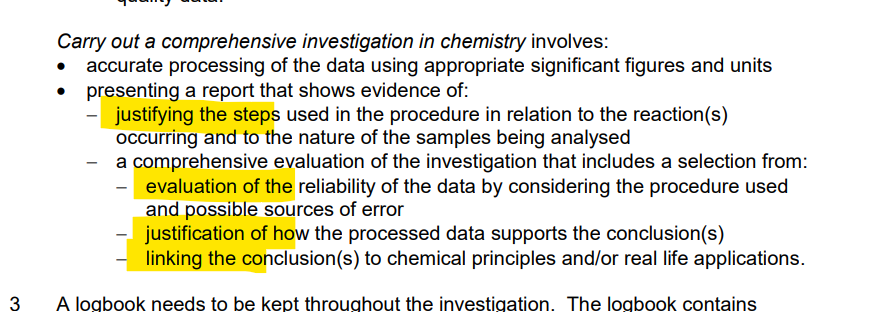
And the merit criteria for L3 Biology 3.1

We are seemingly asking a LOT from our yr 9 and 10 students. AND what will this leave for the 11-13 curriculum? If students at yr 9 and 10 are engaging in independent scientific inquiry…???
Phases/progressions of ideas
This is difficult to ‘summarise’ because there is so much detail!! (SOOOO MUCH). But I have several ponderings and questions, some more ‘helpful’ than others.
So, I’m picking on some ‘strands’ to unpack a little more. Starting with ‘body systems’ in the Biological Science ‘Strand;
Yr 1 has this learning outcome….
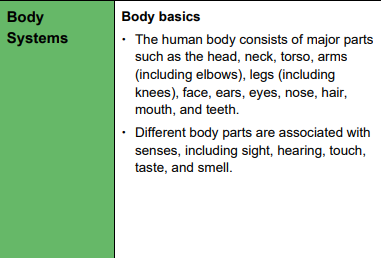
Which I am 100% sure most kids would learn in an ECE setting. AND I am (only mildly taking the piss) wondering if this would lead to a Science lesson being ‘heads, shoulders, knees and toes’ (which if I’m really leaning into it could combine PE, Performing Arts and Languages with Science all in one hit!!)……
Which then progresses rather quickly into yr 2 and 3

Some-one more educated than me can tell me how plants get carbon dioxide from somewhere other than the air….. AND you can laugh with (maybe at) me for having a moment and questioning all I know about Science when I wondered why plants are under ‘body systems’…. Having to re think and re look up the definition of ‘body’
But to my mind we have human body parts at yr 1, then animal (which does include humans) body parts at yr 2, and then all about support and movement in yr 3. It seems to get deep quickly. However, there is no explicit – so what?? Why is this important? What happens if animals/people don’t eat well? Get enough sleep? Have clean water?
And then into a lot more detail about specific processes in 4-6

Now, I’ve taught in 3 different high schools, and all had circulatory systems in yr 10, not yr 6. There is also an assumption at yr 6 that students will remember digestion from yr 4, as it is not covered in yr 5. It seems a large complexity jump, going from two single systems in yr 4&5, to the interconnectedness of the systems in yr 6. I am aware repeated exposure is good for long term retention, but maybe skipping for a whole year is too long? (Side note, respiring using gills?????)
Circulatory systems gets skipped at yr 7 (for diffusion!!) and the yr 8 body systems is so long I had to make it really tiny to fit into a screen grab

Reproduction also resurfaces again in yr 8, not at all touched on in yr 6 or 7.
AND then reproduction is not mentioned at all in yr 9 and 10. Osmosis currently sits in yr 12 Bio!! AND the circulatory systems is touched on in yr 9 – however I suspect students will need a significant reminder as it wasn’t really part of 7-8. Homeostasis is currently in Yr13 Bio!!

Which then makes me concerned about the possible content for yr 11 – if (for example, I could have picked other strands) reproduction is in the yr 11 content, and students did not get it in their yr 8 year (because it wasn’t the curric for 2025) then how will they access that info? Do we need to spend next years yr 9 covering the curric that was expected????? (This is obviously impossible)
Two other little side notes/points of interest so far about the ‘bio’ side – reproduction and genetics are separated – and genetics is in yr 9

Gene activation is quite ‘crunchy’ for yr 9 I thought.
AND there is no evidence of gene ‘editing’ etc in the genetics sections of bio, but it pops up in yr 10 technology – where there is a super fun looking biotech ‘strand’ that I would love to ‘steal’ some ideas from for a science course, but will this be allowable? Does it have to stay in tech? Will it stay in tech for yr 11-13? Not all of the yr 9 and 10 tech strands are compulsory – so what if this doesn’t get covered?

A reason to pick Body systems to start was that there are ‘knowledge’ at every year level. Some of the physical Sciences do not have ‘knowledge’ ‘substrand’ at every year level. And some ideas seem to weave across multiple ‘subjects’.
For example, there is no Matter Interactions and Energy at yr 5…. Which leads me into another ‘where is the progression’ with electricity….. Simple circuits step in at yr 6. After thermal energy (rather than heat??) at yr 4. and nothing at yr 5? So progression is?? Anyways, no I’ve no problem with electricity at yr 6 – some kits here, or some copper tape and paper circuits, maybe with some microbits and some coding could be really cool.


And, what do you know, those components (and some more) are all in the tech curriculum as well – winning maybe?

Except electrical circuits are not then explicit in the 4-6 tech curriculum?
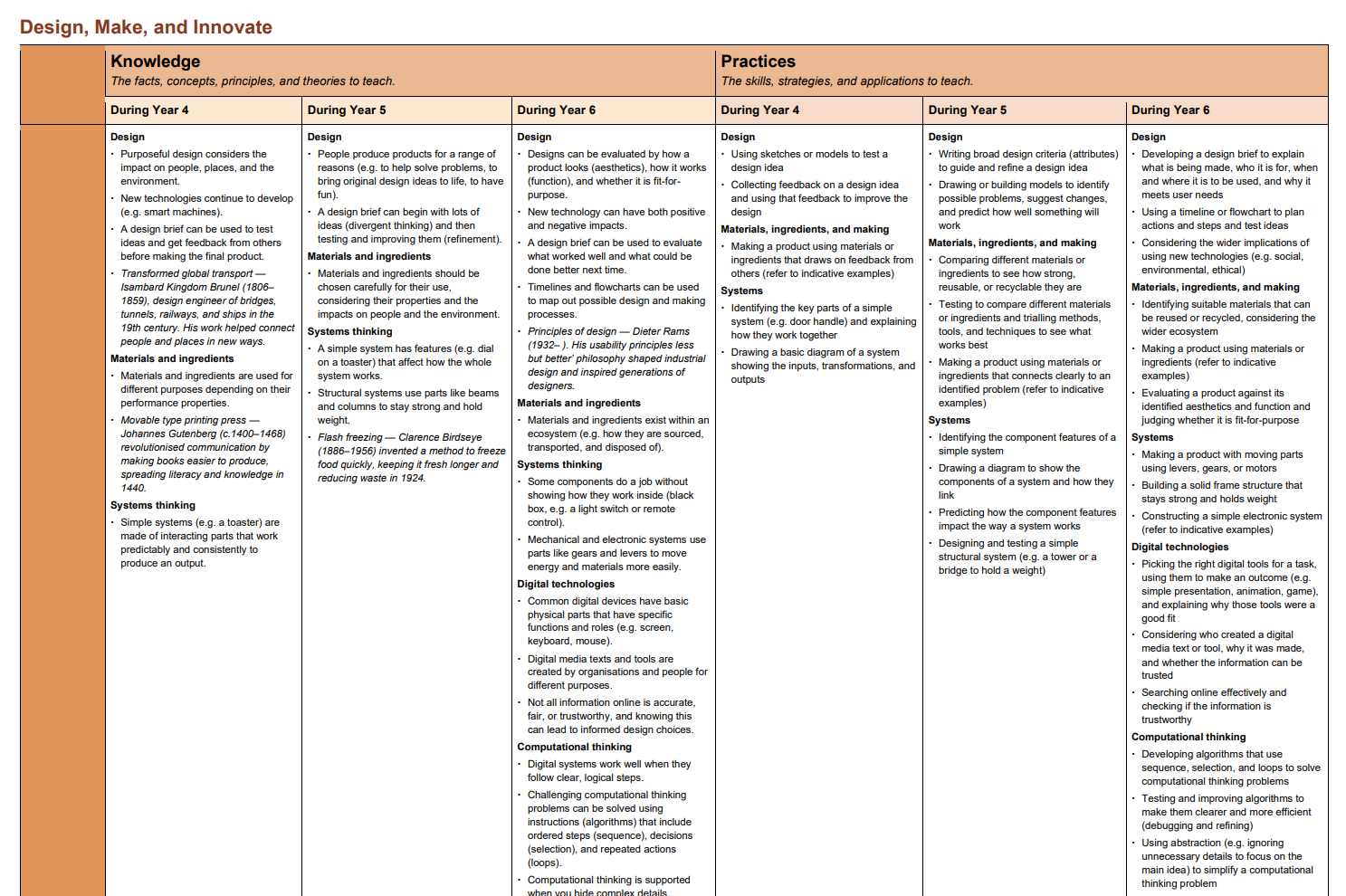
But it is in the yr 7 and 8 tech curriculum
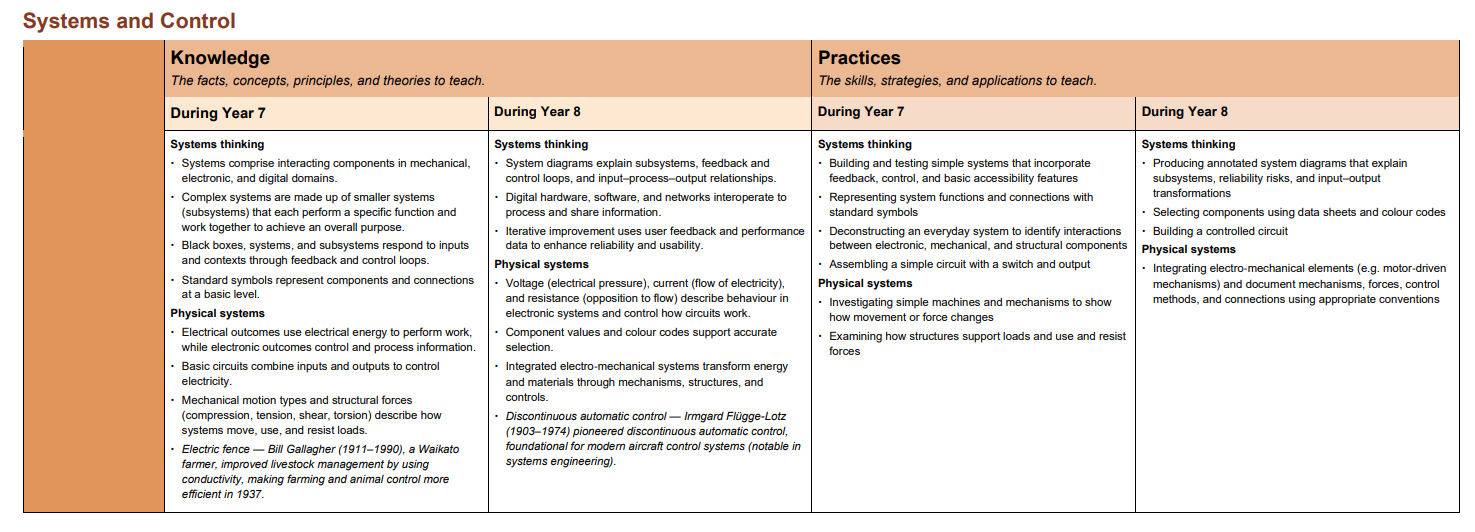
NOTE the definition of Voltage at yr 8 – electrical pressure….
We then leap back to the Science curriculum to yr 8, and hello a different definition of voltage (difference in electrical potential) and why, there is OHMS law (which is currently in the yr 11 PESS physics external). (Added to this ratios and fractions are not in maths till yr 9!)

Trying to ignore the mistakes/typos/AI hallucinations of formulas with mixtures of units and symbols – I do not see a clear progression here. Nor any indication this is age appropriate learning. Especially when you add in series and parallel circuits, electric fields etc.
So yeah, learning about is in no way coherent in this electricity example. AND it then finishes at yr 8. No electricity in yr 9 or 10 in Science. Which seems odd, given it must be a predictable thing for electricity to be in at least some of the senior physics subjects???
Another example of ‘interesting’ progression is nutrient cycling, this time it weaves in and around the social sciences curriculum.
For 1-3, all earth sci is in soc sci
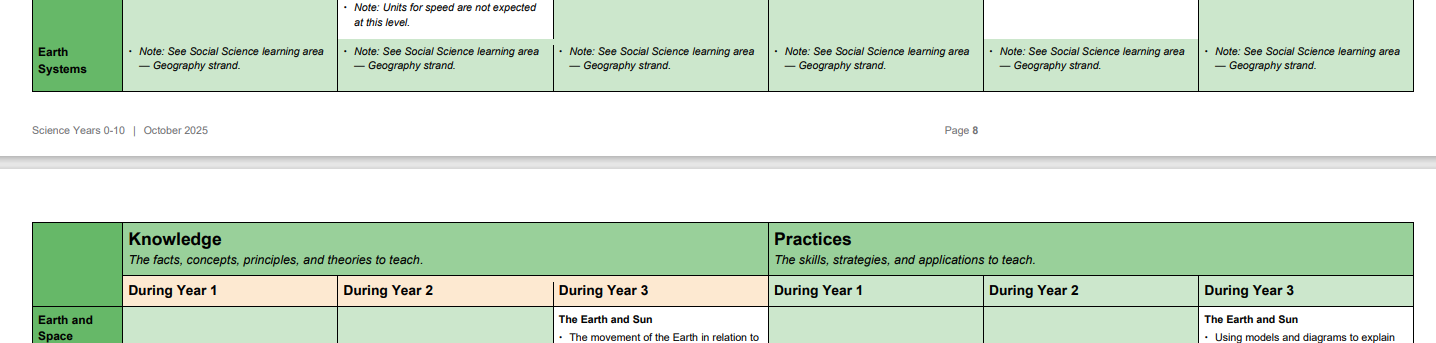
AND no earth and space for the littlest learners either.
We then have ‘states of matter’ in the atmosphere at yr 4 (I am also questioning Thermal energy here…. Is it inaccurate? Over simplified? Radiation from the sun heats the atmosphere right??)

So a maybe water cycle at yr 4….. Then into rocks at year 6. AND year 7
In yr 7 Social sci, there is a big geography unit on water (Do NOT get me started on population at yr 8 – in my opinion the last thing any 12 yr old girl needs to hear is her getting an education means less babies. FFS. Maybe at yr 12 or 13 when this can be put into deeper perspectives… but at yr 8!!)
Anyways, water cycle seems embedded in Yr 7 Geography – along with a whole bunch of ‘worldly’ rivers (Taieri, Clutha and the Rakaia sneak in there, South Island represent)

And some rocks at yr 7 geography too – again not matching the Science
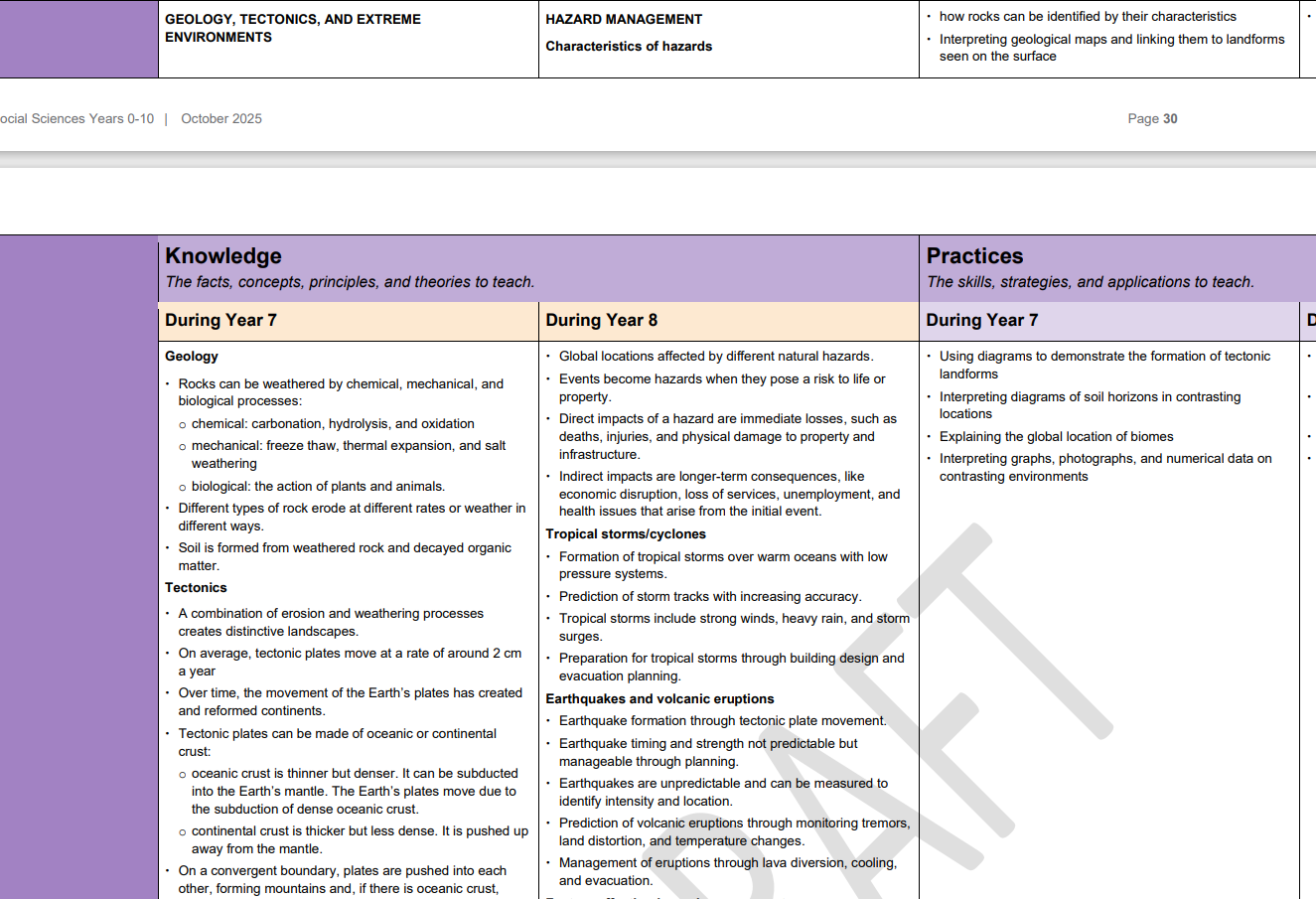
…at least complementing maybe?? The soil idea is in yr 6 in the Science doc.
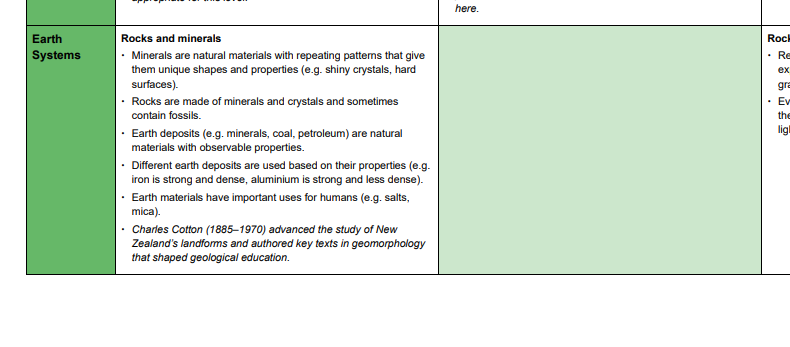
Yr 7 Soc sci also sees some plate tectonics – a command F find found no mention of tectonic plates in the Science document. Or Volcano. Or earthquake. All are over in Social Sciences. Where it seems to stop at yr 8. Managing hazards is yr 9
Yr 9 and 10 Science both have Earth System sub strands

With some more nods towards water cycle in yr 9, and a big push on Carbon cycle in yr 10 ( again with some questionable language).
I couldn’t find the nitrogen cycle anywhere – maybe it is too difficult? Nitrogen fixation is a specific process after all. But then the yr 10 chem sub strand has displacement reactions, and reactivity series… and seemingly 2 of the old level one stds. SO MUCH CONTENT
So it is another example of how the progressions are not in any way explicit. Not within the learning area, or across the different learning areas.
Some other interesting ‘wonderings’ I have noted are
- units of volume are in different yrs of the maths and science curriculum.
- I feel a lot of the ‘Material’ substrand, especially the properties, overlaps with the properties in the tech curriculum.
- I don’t see the progressions in the practices – that might be another blog post.
- There are lots of inconsistency – eg in year 1, seaweed are called plants, but then the next bullet point seaweed are algae.
- Solubility at yr 8 seems way to hard, and asking for misconceptions that will make life more difficult in senior years
- Particle model at yr 8
- I’m battling with all the energy concepts – will need to spend more time unpacking this strand and maybe check in with the physics teachers. But the ‘thermal energy’ stuff all seems off to me. As does some of the gravity stuff, especially in yr 5.
- Fluids, resistance and buoyancy at yr 5!!!
- Another person has pointed this out – but the ‘Scientists’ mentioned are overwhelming male, and dead. Very very dead. And some of the people mentioned are questionable…
- AND on this – they talk about Bohrs model of an atom, but then don’t include BOHR in the names (they do include Rutherford!!)
So, I just don’t see how this curriculum is meeting the repeatedly stated aim of coherence and clear progressions. I don’t see how I can implement this for my learners. I am struggling to see past the errors.
AND I really really worry for my Mr 13, who is going into yr 9 next year and what will be waiting for him in the new ’11-13′ in 2 short years.
Good luck everyone.
 ibpossum takes on tech